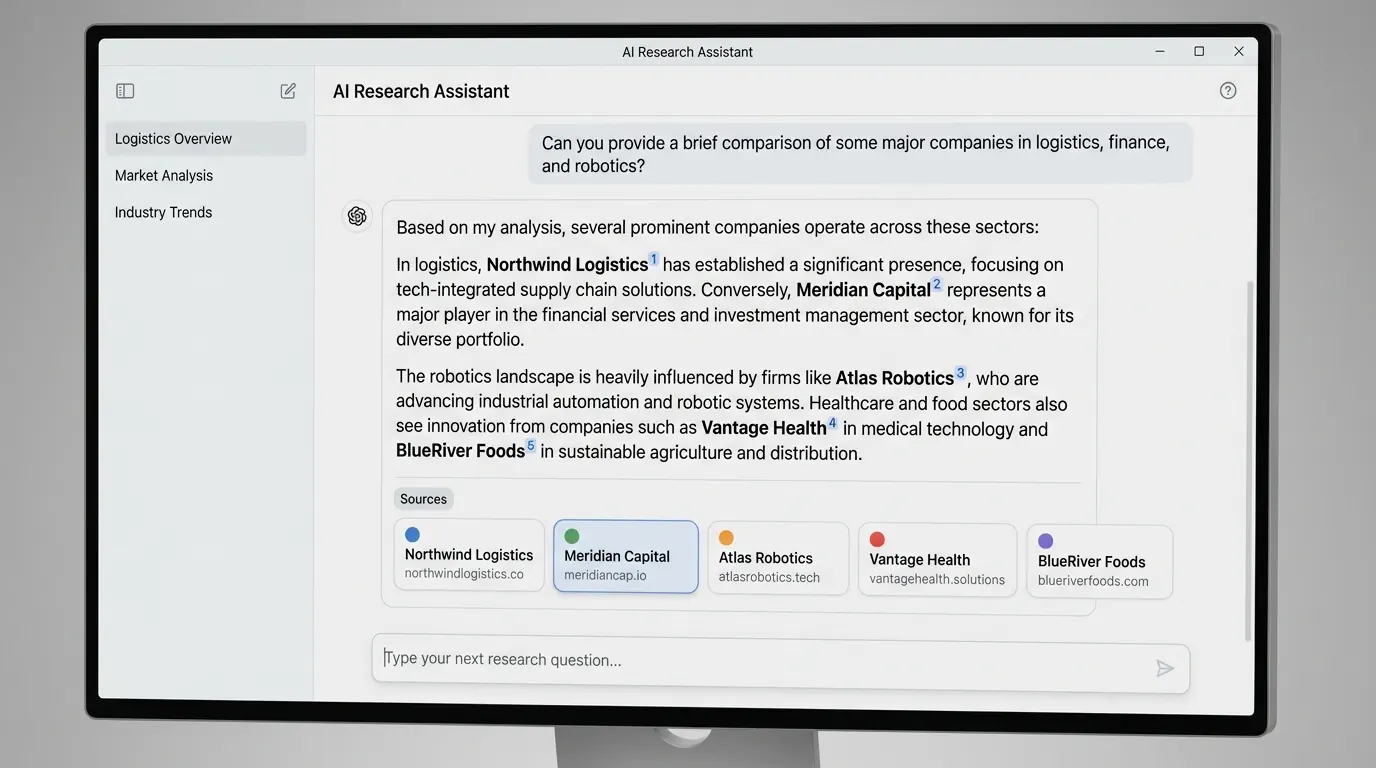
Here is why that should reach a board. When an AI assistant answers a buyer's question, the citation is the referral. It is the one click that leaves the chat and lands on someone's site, and increasingly it lands instead of a search result, not alongside one. The assistant is becoming the first screen a customer sees. The citation is the door out of it.
That quietly rewrites the job. For twenty years the question was where you rank on Google. The new question is whether the assistant credits you when it answers on your behalf, because a growing share of buyers never reach a results page at all. A citation is a distribution channel you do not own, cannot currently buy, and until recently could not even measure. That is why this belongs on an executive agenda and not just a marketing one.
Nobody at the labs will tell you how it works. So we did what we do with any opaque system. We read the patents and the studies published through early 2026, watched where the traffic actually went, and wrote down the parts that held up.
Four kinds of citation
Independent research points to four distinct things happening under the word "citation." They are not interchangeable, and they call for different responses.
The link shaped the answer. The model read it, used it.
The link is attached but did not support the claim.
Your content used, with no link and no mention at all.
See all four side by side
| Type | What it is | What the data says |
|---|---|---|
| Grounded | The link shaped the answer. The model read it, used it. | The visible layer everyone optimizes |
| Ungrounded | The link is attached but did not support the claim. | 56% of Gemini 3's correct answers |
| Ghost | A source link with no brand name in the answer text. | 61.7% of AI citations |
| Invisible | Your content used, with no link and no mention at all. | ~50% of pages ChatGPT retrieves |
The rest of this piece is what each row means for you, and where the real room to move sits. Before the four types, one question decides most of it: what is choosing the sources in the first place.
What is actually choosing the sources
No leading assistant has explained its citation algorithm or offered optimization guidance. What you can do is line up the sources an assistant cites against where those pages rank in ordinary search, and a pattern shows up. The best available inference from that comparison is that Google's index sits behind ChatGPT, Gemini, AI Mode, and Grok, while Brave's index feeds Claude and Perplexity. It is inference, not a spec sheet, and you can run the same comparison on your own cited pages to sanity-check it.
Rank your cited pages on both engines and compare. The overlap is the signal.
If that holds, the practical takeaway is unglamorous. Ranking well on those two search engines raises the odds of being cited by the assistants that lean on them. Classic search visibility did not stop mattering. It became the raw material for something downstream.
One exception is worth naming. ChatGPT appears to cite its publication partners regardless of where they rank, which means part of the citation surface is a business-development outcome, not a ranking one. Keep that in mind before you treat any of this as a pure engineering problem.
The ones that earned it
A grounded citation is the honest case. The platform ran a search, crawled the page, and used what it found to build the answer. The link is there because the content did work.
The half of the system that behaves the way you would expect, and the half worth optimizing for directly.
This is the half of the system that behaves the way you would expect, and it is the half worth optimizing for directly. If your page clearly answers the question a buyer is really asking, in language a model can lift, it has a real shot at grounding the answer. Most of what people call GEO is really just doing that well, over and over, on the prompts that matter.
Present, but not load-bearing
An ungrounded citation is attached to an answer without having shaped it. The model already knew the answer from its training and then reached for a reputable name to stand behind it. The link is there to confirm, not to inform. And it is not a rare edge case.
On Gemini 3, 56% of the accurate AI Overviews answers were "ungrounded," meaning they linked to sources that did not completely support the information provided, up from 37% on the previous model.
Sit with what that means. More than half the time an AI answer is correct, the source it shows you does not actually back it up. If you are the business being cited, an ungrounded link still puts your name in front of the buyer, which is worth having. If you are the business relying on the answer to make a call, though, the citation is not the proof it appears to be, and knowing the difference falls to you.
The link without the name
A ghost citation is a source link that appears with no brand name anywhere in the answer text. The reader sees a numbered reference and clicks it, or doesn't, but either way the name of your company never registers.
61.7% of AI citations are ghost citations: the domain gets a source link but the brand name does not appear in the answer text.
This is where a lot of GEO budgets quietly underperform. Teams count how often their domain gets cited and call it visibility. But a link with no name builds very little brand, because the reader walks away having absorbed your information and none of your identity. More citations will not fix that. Content that explains, in your own words, how your product solves the specific problem will, because it gives the model a reason to say who you are instead of just borrowing what you know.
Used, and never credited
The last category is the one that is not really a citation at all. It is the assistant using your content to shape an answer while linking to nothing and naming no one.
Around half of the URLs ChatGPT retrieves are never cited in the final answer.
Retrieval is not citation. A page can be pulled in, read, used to shape the model's understanding of a topic, and then vanish from the response entirely. In the same body of work, forum threads are a clear example: Reddit content gets retrieved constantly and cited almost never, which means it shapes answers from behind a curtain. There is a decent chance your own content is quietly doing the same thing inside a competitor's answer.
Where to start
The uncomfortable part of all this is that being cited and influencing the answer are two different outcomes, and most teams optimize for the first without measuring either. Here is the order we run it.
- 1
Measure before you optimize
Get your current citation share before you change anything. The cost of not knowing it is simple: buyers are already asking these assistants about your category, and if a competitor is the one being cited, that referral was yours to lose. Run the prompts your buyers actually use, on the assistants where they use them, ChatGPT, Claude, Gemini, Perplexity, and record who gets cited, who gets mentioned, and who gets neither. This is the Baseline and Bearing part of ourAZIMUTH method doing ordinary work: you cannot optimize a number you have never written down, and this one moves week to week. Standing it up is cheap. For a defined set of buyer prompts it is a few days to build the tracker and a standing cost to re-run it, because a citation baseline is only useful if you keep taking it.
- 2
Separate the four outcomes
Then split your own results by type, because this is the step most tools skip and it is more work than printing a citation count. A domain that is cited but never named is a ghost-citation problem, and the answer is content that names the brand in context, not more link-building. A page that gets retrieved but never cited is an invisible-citation problem, and the answer is a clearer title, a readable URL, and content that directly answers the sub-question. Those are different fixes for problems that look identical in a dashboard that only counts citations.
- 3
Keep the search work going
The classic rankings still matter, because on the current evidence Google and Brave feed the assistants. Appearing in any answer beats not appearing, especially when your products are what the buyer asked about. What exposes your brand to the model in the first place is a direct or indirect association with the prompt, so that association is where the priority sits before any of the finer optimization on top of it.
Write the kill criterion first
Set it before you start, not after. Ours for this kind of engagement reads roughly: if three months of citation work has not moved cited-and-named share on the prompts that matter, we stop, we say why in writing, and we put the budget somewhere with evidence behind it. A citation is still a distribution channel you cannot buy, which is exactly why it is worth a real attempt and exactly why that attempt needs a defined end. Deciding the stop in advance is what keeps a visibility project from becoming a dashboard nobody is allowed to question.