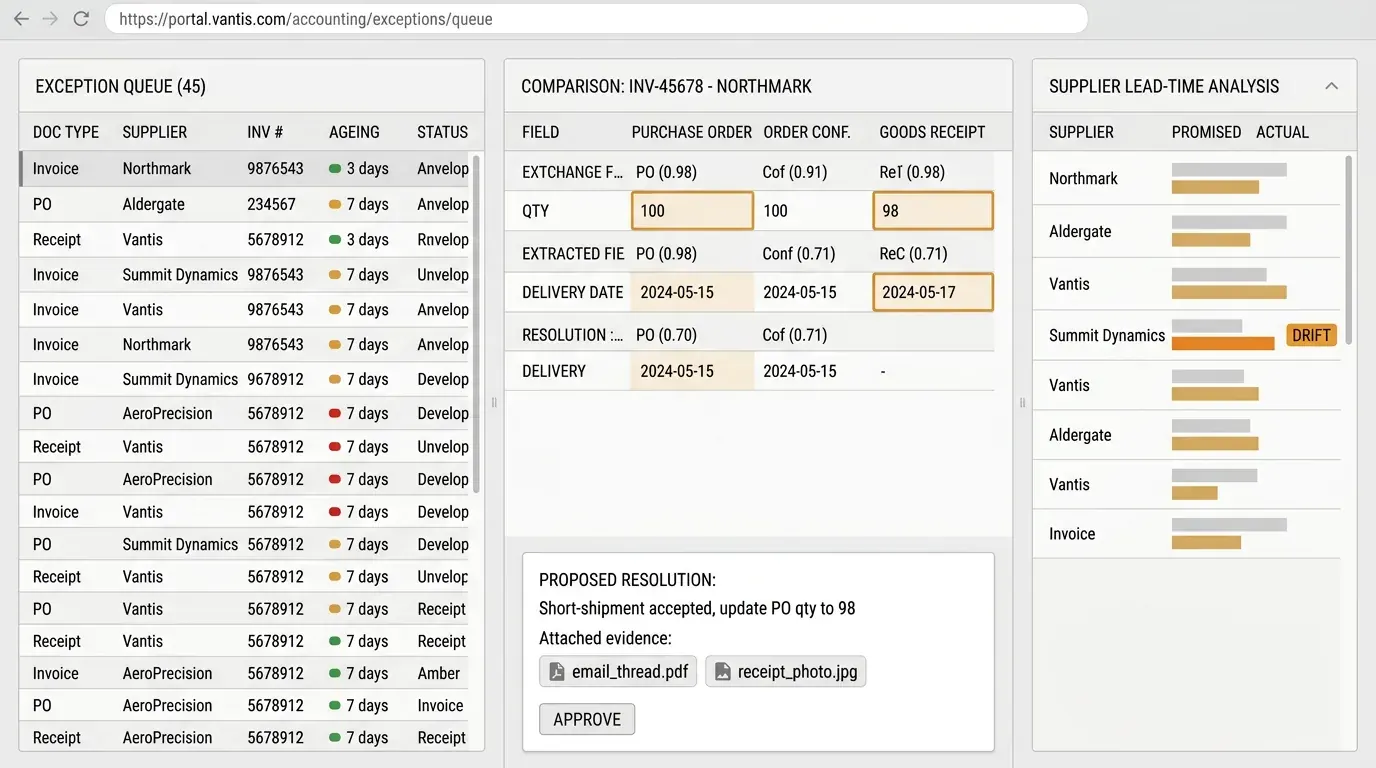
Mismatches were discovered at goods receipt. By then the truck has arrived and the only options left are expensive.
Procurement and supply chain4 min read
Sector, size, and function are stated. The client is not.
Handwritten extraction dropped
At a glance
Sector
Industrial distribution
Function
Procurement and supply chain
Documents
Order confirmations, shipping notices, invoices
Sampled
Twelve months, top forty suppliers
Work stopped
Handwritten delivery note extraction
Engagement
Extraction build plus ERP integration
The short version
Most eligible documents now process untouched
Two people were keying PDFs and email attachments in dozens of layouts. The keying time fell with the touchless rate.
Exceptions surface at confirmation, not at receipt
The more consequential change. At confirmation somebody can still do something about it; at goods receipt the truck has arrived.
Supplier reliability is measured rather than recalled
Actual lead times per supplier and per lane now exist as a dataset, and they entered the annual supplier reviews.
Why timing mattered more than keying
Two people keyed supplier documents into the ERP by hand. They arrived as PDFs and email attachments in dozens of layouts.
Expediting ran on phone calls and personal relationships, which works right up until the person with the relationships leaves.
Document extraction has become reliable enough for structured commercial documents, but the value is not in the keying. It is in catching the mismatch at confirmation, while somebody can still do something about it.
Twelve months of documents, read properly
Layout variety is the thing that kills these projects.
Workshops with procurement and the warehouse team. Twelve months of documents from the top forty suppliers were sampled to understand the layout variety and the failure modes.
Match rules and tolerance thresholds were agreed line by line. So was the list of exceptions a person must always see.
The data job covered supplier master cleanup and item cross-referencing between supplier part numbers and internal SKUs.
It also produced actual historical lead times per supplier and per lane. That dataset had never existed. Until then, a lead time was whatever the supplier said it was.
Kill note, recorded during the trial
Handwritten delivery notes from smaller suppliers were trialed and abandoned. Field-level accuracy was low enough that checking the output cost more per document than keying it from scratch. Those suppliers moved to portal submission instead.
bearingbridge.ai project record, phase Fix
What was built, and how it fails
Three components, and one honest weakness.
Extraction pipeline
Documents in, structured records out, with a confidence score on every field.
Three-way match
Order against confirmation against receipt, within the agreed tolerances.
Exception queue
Each item arrives with a proposed resolution and the supporting evidence attached.
Every extracted field carries its confidence score. The lead-time panel on the right is what turns a document problem into a supplier conversation.
A lead-time signal flags confirmations that slip against the promised date, which surfaces supplier drift before it becomes a stockout.
Records write to the ERP after approval. Nothing posts automatically.
The failure that matters is confident extraction of a wrong value, because a low confidence score routes to a person and a high one does not. Field-level accuracy is audited monthly against a held-out sample, and the thresholds have been raised twice.
Where it stands after a few months
Touchless processing now covers most eligible documents, and keying time fell with it.
The more consequential change is timing. Exceptions surface at confirmation rather than at receipt.
Supplier reliability is now measured rather than recalled, and that measurement entered the annual supplier reviews.
Months later the touchless rate had held and two suppliers had changed their confirmation practice after seeing their own numbers.
Three things that made it work
Lead times got computed rather than asked for
The promised number and the actual number turned out to be different things, and no one had checked in years.
Tolerances were agreed line by line
Tedious and unavoidable. An exception queue is only useful if what lands in it is genuinely exceptional.
One document type got dropped
Handwriting failed the cost test, so it was routed around instead of forced through with a worse model.
Figures on this page are client-verified and published with permission. Where a figure is absent, the outcome is described in operational terms instead.
A conversation with the senior team about your markets, your data, and where AI would actually pay back for you. No slides, no obligation, and if the honest answer is that AI is not your next move, you will hear that too.