
I spent this weekend building, which was supposed to be the whole plan. The writing was an accident.
The building came first. Two agents, neither of them exotic, the kind of thing my team ships for clients most weeks. One reads a pile of unstructured internal documents and answers questions against them with sources attached. The other drafts and routes responses in a support queue and stops for a human before anything goes out.
I worked alone. Nobody to brief, nobody to hand anything to.
By Sunday afternoon I sat back and did the math. Eighteen months ago that same weekend would have taken a small team a few weeks. Not because anyone was slow. That was just the shape of the work back then, and nobody thought twice about it.
A document agent that answers with sources attached, and a support agent that stops for a human before anything goes out. Nobody was slow eighteen months ago. That was the shape of the work.
So I opened a document instead of a terminal, which is not what I’d planned for a Sunday.
We spent a year being told AI would wipe out white collar work. Then the year ended. Unemployment didn’t spike. Most people still have their roles. The economy looks roughly like it did twelve months ago.
So a lot of people have filed AI under “overhyped” and moved on. Another cycle. Another tech panic that came and went, the way the metaverse did.
I understand the reflex. I don’t share it, and I’d like to explain why without sounding like someone with a product to sell, which I am.
The collapse hasn’t happened yet because we are still at the beginning of what AI can deliver at human quality or better. Not because it won’t happen.
I’m not writing this from the sidelines
I build with AI every day. My studio makes brand creative entirely with AI tools. My team ships agents and products for clients. I teach this at a graduate school, which mostly means I get asked questions I can’t answer yet.
That gives me a narrow but useful view. I’m not reading about capability curves. I’m watching my own invoice math change month by month.
From that seat, the “nothing happened” reading is hard to square with what’s on my screen.
Two years ago this took four people
Two years ago a single campaign asset needed a designer, a copywriter, a researcher, and someone to keep them on schedule. Four people, a week, plus revisions.
Four people and a week, plus revisions. The color grading still argues.
Today most of that sits with one person and a well configured setup. Not all of it, and not perfectly. The color grading still argues with me. But enough that the economics have moved.
When I look at what I produce in a week now, I find it hard to argue that no job disappears from this. To believe that, I’d have to believe the capability stops here. Nothing in the last three years suggests it stops here.
Six functions, and the same skeleton every time
We’ve built agents and products across a wide spread of industries now, in Europe, in Asia, and for companies selling into the US. The functions repeat: marketing, finance, HR, sales, data analytics, customer service.
Here’s what surprised me. The feature sets rhyme.
In marketing it’s asset generation with brand rules enforced at the gate. In finance it’s document extraction and reconciliation with an exception queue. In HR it’s screening and policy answers with an audit trail. In sales it’s account research and proposal drafting. In analytics it’s querying messy data in plain language. In customer service it’s triage, draft, route, escalate.
Strip the labels off and you’re looking at the same six or seven parts. Retrieval over documents nobody has organized. Structured extraction. Drafting with a review gate. Routing. Summarizing with sources attached. A human at the end who approves.
Six functions. One skeleton.
- Retrieval over documents nobody has organized
- Structured extraction
- Drafting with a review gate
- Routing
- Summarizing with sources attached
- A human at the end who approves
Six functions. One skeleton. The value is not in the blocks.
The building blocks are converging. The value isn’t in the blocks. It’s in the context.
That’s what makes this different from earlier software waves. Generic capability gets cheap almost immediately. The expensive part is knowing how one particular company actually works, and that knowledge doesn’t transfer. Its vocabulary. Its exceptions. Its approval chains. Its bad habits.
We ship something that looks like the last one and behaves nothing like it, because the context belongs to that company and nobody else. That is also why these builds don’t turn into a product you can sell twenty times without touching it. I’ve tried.
In every case, the client can do more
Worth being careful here, because my claim is narrower than the headlines and, I think, more uncomfortable.
I have not seen a client fire a department because we shipped an agent. Not once, in any market.
What I have seen, every single time, is a client who comes out of it able to do more with the same headcount.
Then comes the part that matters. Somewhere between the pilot working and the rollout finishing, a conversation happens about an open role. Sometimes I’m in the room. The sentence is close to identical across sectors and across markets:
Let’s hold that hire. Let’s see how far this takes us first.
That’s not a layoff. It never reaches an unemployment number, because the only trace it leaves is a job posting nobody writes.
Why managers defer instead of cut
Deferral is the rational move here, which is why it spreads without anyone noticing.
Cutting a person costs money, takes months, damages the team, and forces a public admission that the role was a mistake. Not filling an open seat costs nothing. Nobody signs anything. Nobody gets a difficult conversation. The budget line simply goes unused, which in most companies makes you look disciplined rather than reckless.
- Costs money
- Takes months
- Damages the team
- A public admission the role was a mistake
- Costs nothing
- Nobody signs anything
- Nobody gets a difficult conversation
- The budget line goes unused, which looks disciplined
One of these needs a defense. The other one never comes up.
So a manager who suspects a role might be automatable in a year has one obvious play. Wait. Run the existing team harder with better tools. Revisit at the next planning cycle.
The freeze isn’t a decision anyone announces. It’s a decision nobody has to defend.
Repeat that across a few thousand companies and you get what we have now. Stable employment. Stable unemployment. And a hiring market that everyone I talk to describes as strange without being able to say why.
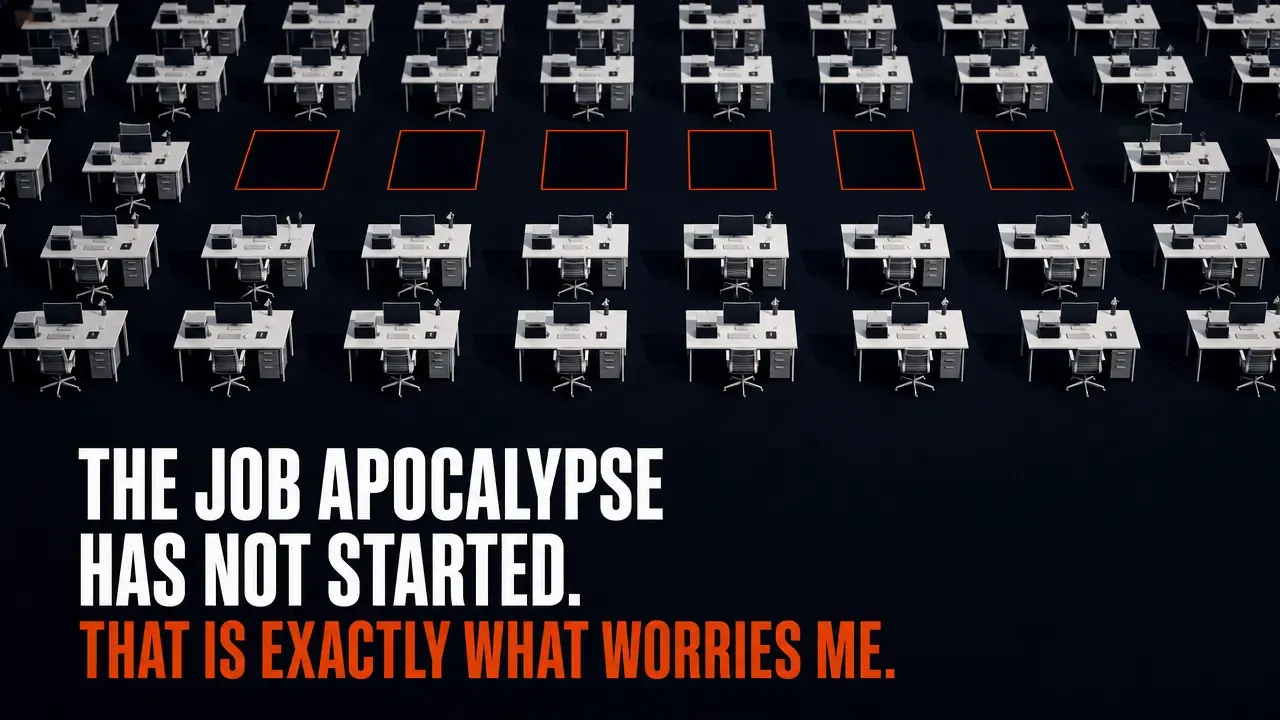
Jobs aren’t being destroyed. They’re being deferred.
Here’s my position, stated plainly.
Jobs are not disappearing at scale yet. What’s disappearing is the reflex to hire for anything that isn’t essential.
Essential roles still get filled, along with anything revenue critical and anything where a mistake gets expensive fast.
Everything in the middle waits. The coordination role. The second analyst. The junior who was going to do the first pass. The support hire. The “we probably need someone for this” job that used to get signed off without much argument.
- The coordination roleon hold
- The second analyston hold
- The junior who was going to do the first passon hold
- The support hireon hold
- The “we probably need someone for this” jobon hold
That’s not destruction. It’s deferral, and it’s much harder to see.
Who pays first
So far this reads like an accounting story. It isn’t. Somebody absorbs it.
If you want to know who pays for this first, it isn’t the senior person whose judgment the company is buying. It’s the person who was going to be hired in order to learn.
Entry level knowledge work was built on a simple trade. The junior does the first pass, the research, the draft, the cleanup. That work is slow and imperfect, and companies tolerate it because in three years the junior becomes the person who can do the hard part.
An agent does the first pass now. Faster, cheaper, at two in the morning, without asking for feedback. The immediate math is obvious to everyone in the room. Nobody’s job description covers the three year math.
I don’t have a clean answer to this. When the question comes up in client conversations, the answers don’t survive much pressure, and I don’t think that’s carelessness. The cost lands in a future quarter. The saving lands in this one. Almost nobody is paid to optimize for the first.
Why it’s getting harder to justify certain hires
Two things shifted at once, and they compound.
The first is capability. A good share of the tasks that used to justify a headcount can now be done well enough by a configured system, on demand, at a monthly cost closer to a software license than a salary. That is the comparison the budget holder is making, whether or not it’s fair.
The second is harder, and it’s about value.
If a role was mostly production, that contribution is now cheap. Making the deck. Writing the report. Building the campaign variant. Drafting. Reconciling. Answering the ticket. Those were real jobs built on real effort. The effort has collapsed.
Justifying the hire is getting harder. Justifying a premium for the value that position used to represent is getting harder still.
What survives is judgment. Deciding what to build, when to stop, what’s wrong, what to risk. I do believe that.
But judgment was never the thing that got billed. It rode along inside the hours and the headcount, invisible, priced by accident. Remove those and the vehicle that carried judgment to the invoice goes with them. I haven’t solved that for my own business either, and I’m not going to pretend I have.
So what would I watch instead?
If the effect is a hire that never happens, then the standard dashboard can’t see it.
Unemployment is a lagging measure, and a blunt one. It counts people who lost a job. It doesn’t count jobs nobody ever created.
If I wanted to catch this early, I wouldn’t watch the unemployment rate. I’d watch:
- Job postings that quietly stop appearing for specific functions
- The changing skill mix inside the postings that do appear
- Entry level hiring volumes in knowledge heavy sectors
- Budget moving from labor lines to tooling and infrastructure lines
- How long a vacancy stays open before someone decides it doesn’t need filling
The last one is the most underrated signal on the list.
That last one is the most underrated signal I know. A role that sits open for nine months has been eliminated in everything but paperwork, and nobody sends a memo about it.
Where I could be wrong
This next part matters, because I’m inside the industry and inside the incentive.
I sell AI capability. That’s a reason to discount my forecast, not to accept it. People who build a thing tend to overestimate how far and how fast it travels. I’ve been early before, and being early is just being wrong with better excuses.
The current architecture may plateau. This isn’t a fringe position. The leaders of the largest AI labs have each said publicly, in the past year, that reliable long horizon autonomy will need something beyond the architecture behind today’s chatbots. None of them has shown that successor working at scale. If the plateau arrives first, the deferral I’m describing partly reverses. Companies wait, find out the systems can’t close the gap, and hire again.
There’s also a version where the shift is real but lands somewhere nobody expects. Cheaper intelligence could grow demand instead of shrinking employment. That has happened before with other inputs. The spreadsheet was supposed to end bookkeeping and instead produced more financial analysts than the world had ever employed.
I don’t know which of these lands. Nobody does. What I’d rather not do is find out by waiting, because the cost of being wrong isn’t symmetrical. If I overprepare and the plateau arrives, I’ve lost some evenings. If I underprepare and it doesn’t arrive, I spend the rest of my career explaining what I used to do.
If you want something to do on Monday
None of that is a reason to sit still. Here’s what I’d do, and roughly what I am doing.
Find out what you’re being paid for. Not the job title, the decision underneath it. If you sit down and can’t name the judgment you applied last week, you’ve learned something worth knowing.
Build something with these tools until you hit their limits yourself. Reading about the limits doesn’t count, and I say that as someone who reads a lot about the limits. The people I see adapting fastest are the ones who broke something and then had to fix it.
Then get closer to the decision. Every function I’ve worked in has a layer where someone chooses and a layer where someone produces. The producing layer is getting repriced right now. The choosing layer isn’t, at least not yet.
Three things I’d defend
The absence of a collapse is not evidence that nothing is happening. What I see running is quieter than a collapse and much slower to reach the data.
The freeze on non-essential hiring isn’t temporary caution either. This is a repricing. Once a company finds out it can run without a role, it doesn’t go back, and I’ve never seen one go back.
And if your job is mostly production, you have less time than the calm headlines suggest and more time than the loudest voices claim. That gap is the whole opportunity.
The uncomfortable part
The thing I keep coming back to is that this transition won’t feel like an event.
No announcement. No dramatic morning. Just roles that stop getting posted, teams that stop growing, and career paths that lose their first rung while nobody’s looking. By the time it’s measurable, it’s finished.
I’m not predicting an apocalypse. I’m saying the apocalypse framing is what lets everyone relax, because when the apocalypse misses its date, we decide nothing is happening.
Something is happening. I see it in my own P&L, in my delivery, and in most client conversations I’ve had this year. It just isn’t loud enough to make anyone act.
Written at the end of July 2026. I’ll revisit this in six months and mark up what I got wrong. If you want that follow up, it goes out to mynewsletter list.