Two people ran paid search and a professional network alongside everything else demand generation owns. Testing eight ad variants costs an afternoon, so it never happened.
Demand generation4 min read
Sector, size, and function are stated. The client is not.
Both ad managers retired
At a glance
Sector
B2B software
Size
Mid-market
Function
Demand generation
Data cleaned first
Historical campaign exports from both platforms, CRM stage mapping, landing page inventory, keyword trend history
Interfaces retired
Both ad managers, in normal operation
Engagement
Build, then supported operation
The short version
A campaign now launches the same day it is briefed
What used to be a week of assembly across two interfaces is a brief, a set of proposals, and a click.
Cost per qualified opportunity replaced cost per click
The reporting metric changed, and so did which campaigns looked good. Two of them changed places entirely.
Budget reallocation went from monthly to weekly
Spend follows evidence on a cadence the old process could not sustain, and bid authority stayed exactly where it was.
Why volume was the problem, not judgment
Keyword coverage had gaps nobody had time to find. Ad copy testing was something the team believed in and rarely did. Writing eight variants for one ad group is an afternoon.
The work is high volume and rules-based, and it needs adjusting constantly. It is the shape of task where a system beats a busy person.
There was a second motive, less strategic. The team wanted out of two platform interfaces, each with its own login, its own taxonomy, and its own way of thinking about a campaign.
Mapping conversions came before anything else
None of what follows works without this part.
Two workshops with demand generation, one with sales. Ideal customer profiles got written down properly for the first time, which took longer than anyone expected.
The offer inventory was catalogued and landing pages audited. A naming and tracking taxonomy was fixed across both platforms so results could finally be compared to each other.
Keyword work ran in parallel. Current coverage, competitor gap analysis, and trend history rather than the snapshot most tools hand you.
The data job that mattered was mapping conversions back to CRM stages. Until that existed, the team could optimize cost per click and nothing more useful.
Budget guardrails and bid limits were agreed and written into the rules before launch, not after the first overspend.
What was built, and what it gets wrong
The build itself took a fraction of the timeline.
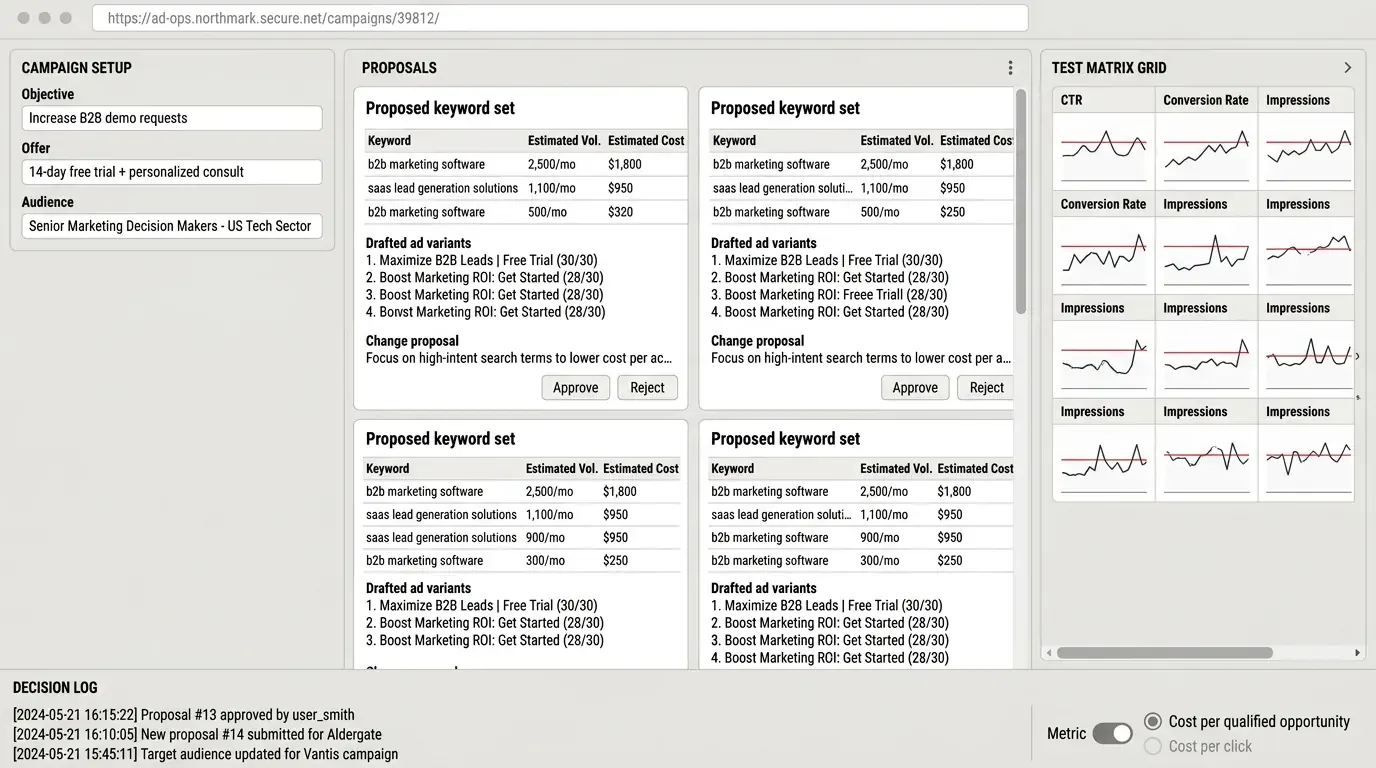
A campaign workspace. The team briefs a campaign in one place, and the system does four things.
Proposes keyword sets
With volume and estimated cost attached.
Drafts ad variants
For each platform’s formats.
Builds the test matrix
And monitors it against agreed thresholds.
Proposes changes
With the reasoning attached, approved with a click.
One brief, one proposals feed, one decision log. The metric toggle at the bottom is the part that changed the arguments.
Both platforms connect through their APIs, so neither ad manager gets opened in normal operation. Versions, tests, and decisions sit in one log.
When a proposal is wrong, and some are, it gets rejected in the workspace and the rejection is logged with a reason. Those rejections are reviewed monthly and have changed the rules three times.
Finding, from the first month of CRM-mapped reporting
Two campaigns that led on cost per click ranked last on cost per qualified opportunity. Both were bringing in volume that never reached a sales conversation. Neither would have been caught without the stage mapping.
bearingbridge.ai project record, phase Data
Where it stands after a few months
Launch time for a new campaign collapsed. Keyword coverage widened into terms the team had not been bidding on.
Budget reallocation moved from monthly to weekly, and cost per qualified opportunity fell against the baseline measured before the build.
Months later the workspace was still the only place the team touches paid media. Bid authority sits with the demand generation lead, unchanged from before.
Three things that made it work
CRM mapping came first, and it had to
Without it the system would have spent months optimizing a metric that does not pay anyone.
Guardrails were set before launch
Bid limits and budget rules got agreed while nobody was under pressure to hit a number, the only time those conversations go well.
Approval stayed a click
The team gained speed and kept the ability to say no, and they use it.
Figures on this page are client-verified and published with permission. Where a figure is absent, the outcome is described in operational terms instead.
A conversation with the senior team about your markets, your data, and where AI would actually pay back for you. No slides, no obligation, and if the honest answer is that AI is not your next move, you will hear that too.