One set of assets became per-retailer, per-market, per-audience
Variants stopped being a budget conversation. The adaptations that used to get cut are now the default output of the same brief.
Cost per asset fell against the prior agency rate card
Measured against the retainer’s own per-asset pricing rather than an estimate, so the comparison holds up in a procurement review.
Agency spend moved off production
The retainer now buys concept and photography. Production volume left the rate card entirely.
Why the constraint was variants, not ideas
One campaign concept produced one set of assets. Everything after that got cut: the second retailer format, the third audience, the local-market adaptation. Agency retainers were priced per asset. That turned every extra variant into a budget conversation instead of a marketing one.
What was scarce was tailored output at volume. Creative direction had never been the shortage, and it explains why the tool fit the problem.
Tailoring is the whole job. Food carries claim rules. Each brand has a voice that took a decade to build. Each retailer publishes its own specification sheet. A generic asset generator would have produced work the brand managers threw out and legal blocked on the way past.
Most of the work happened before any build
This is the part clients underestimate, so it gets the most space here.
Six workshops. One per brand, plus two that put all of them in the same room. Brand managers talked through what makes copy sound right. The useful half of that conversation was the opposite: what makes it sound wrong.
Then the collection. Brand books, three years of campaign archives, the legal claims register, and specification sheets from the four largest retail customers.
The data work ran longest. The asset archive had no consistent tagging, so past work could not serve as reference. Photography rights had to be cleared before any image could be used as a source, which held things up for about a fortnight. The claims document had not been touched in two years. It got rewritten and signed off by counsel before anyone built anything on top of it.
We mapped the approval loop as it ran in practice. The org chart version and the real one were not the same document, and it surprised no one who worked there.
What was built, and what was not
After all that, the build itself was the short part.
A brief-to-asset pipeline with two layers under it.
A context pack per brand
Voice samples, claim constraints, product truth, banned language, and the visual rules nobody had written down.
A format template per channel
Each carrying the retailer or platform specification, so an asset arrives correct instead of arriving and then being corrected.
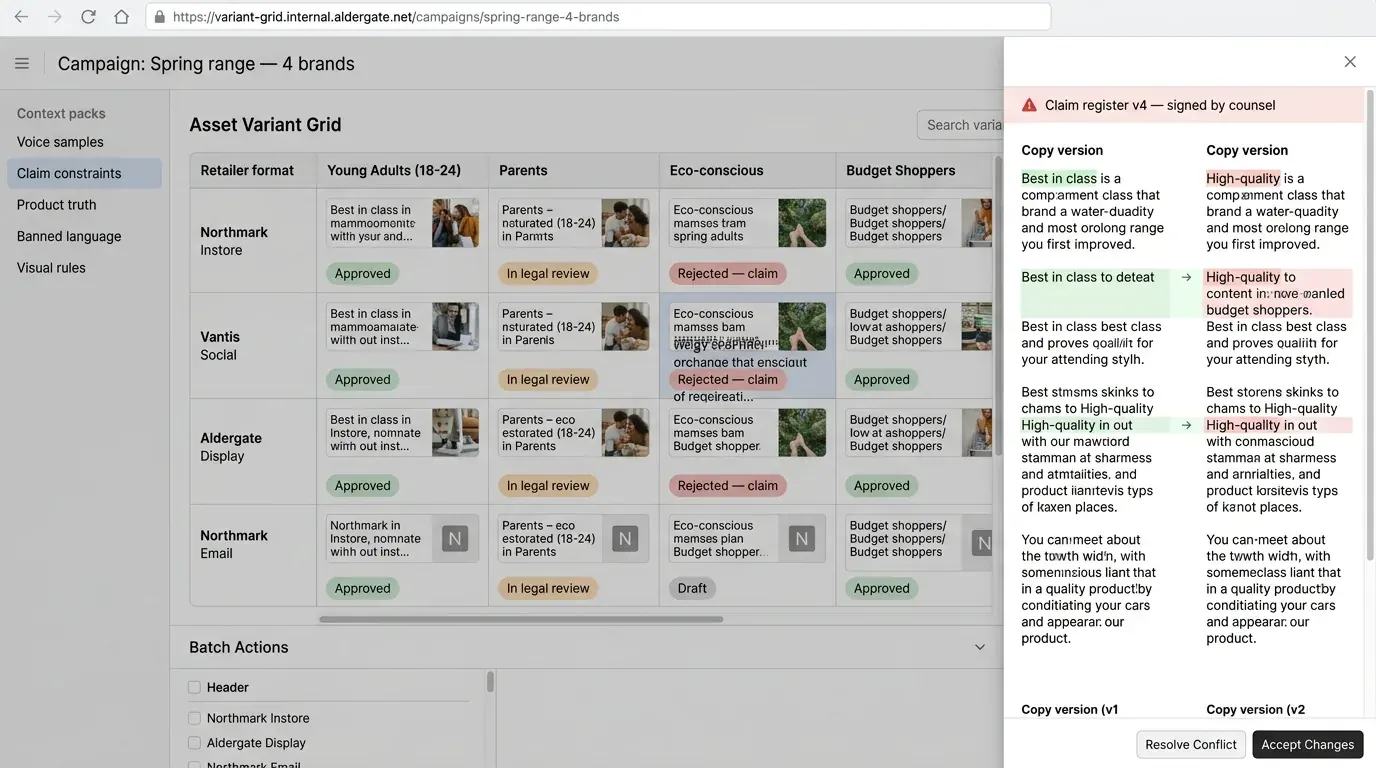
The variant grid. Rows are retailer formats, columns are audiences, and every cell carries its own approval state. Nothing leaves without a person on it.
Copy and still images generate against those packs. Nothing leaves the system without a person approving it, and any claim still has to clear legal.
Video was scoped, prototyped, and stopped. On-pack product accuracy could not be held to the standard the brands required, and music and talent rights were unresolved.
Kill note, recorded at the time
Video was stopped after the prototype, not after a failure in production. On-pack accuracy could not be held to brand standard, and music and talent rights were unresolved. Templated motion from approved stills covers most of the social requirement.
bearingbridge.ai project record, phase Build
Where it stands after a few months
Local-market adaptation moved from exception to default. Variants per campaign went up, and the ones that used to be cut for budget now ship as a matter of course.
The constraint now is human review capacity. A better problem to have than the old one, and it is what the client is working on next.
The pipeline was still running months later, which is the checkpoint that matters. Plenty of these builds work for a quarter and then quietly stop being used.
Three things that made it work
The context packs did the work, not the model
Same model, different context, and the output quality is not comparable. The finding does not flatter anyone selling model access.
Legal moved upstream
Rewriting the claims register before the build removed a review bottleneck that would have surfaced two months later, at the worst possible moment.
One stream was killed
Video got scoped and prototyped, then stopped. Writing down why is what lets the client trust the streams that did ship.
Figures on this page are client-verified and published with permission. Where a figure is absent, the outcome is described in operational terms instead.
A conversation with the senior team about your markets, your data, and where AI would actually pay back for you. No slides, no obligation, and if the honest answer is that AI is not your next move, you will hear that too.